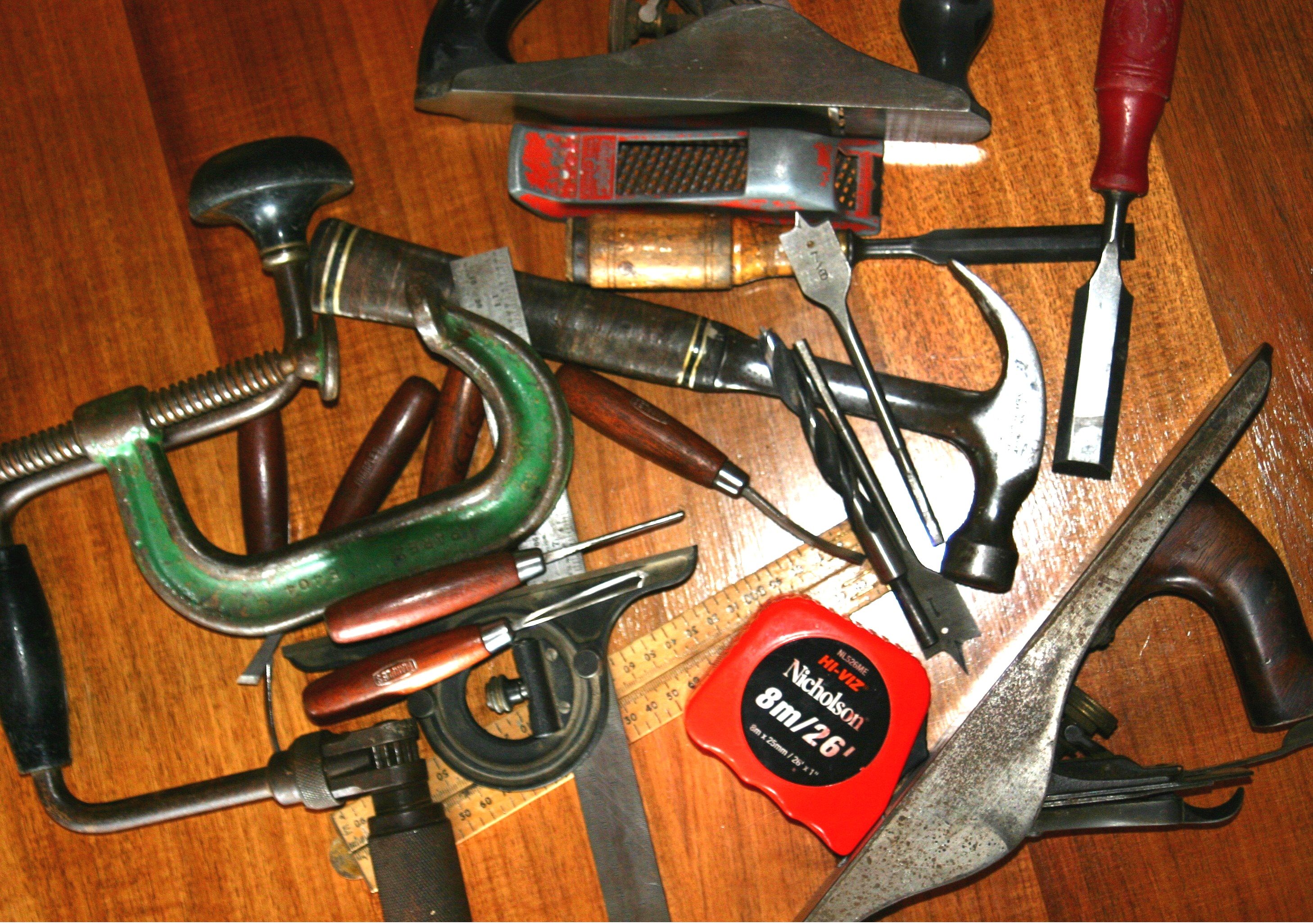
The choice of wood species is the first material decision in any furniture project, and it shapes every subsequent step — how the stock moves under a plane, how easily a chisel pares across end grain, how the surface takes oil, and how the finished piece behaves in a centrally heated Czech apartment over twenty years of seasonal humidity cycles.
Four species dominate Czech furniture production: oak, beech, cherry, and ash. Each has properties that make it appropriate for specific applications and less suitable for others. This article covers what those properties are and how they translate into practical decisions at the workbench.
Oak (Dub) — Quercus robur, Q. petraea
Oak is the default hardwood for load-bearing furniture components in Czech workshops. It is dense — Janka hardness around 5,900 N — with an interlocked or straight grain depending on how the board is sawn. Quarter-sawn oak displays the characteristic medullary ray fleck that defines the appearance of traditional Central European furniture; flat-sawn oak shows a more pronounced cathedraling grain figure.
Oak is durable against wear and moderately resistant to moisture absorption, which makes it the standard choice for table tops, chair seats, and floor panels in Czech production. It machines and planes well when dry but is demanding on hand tools at low moisture content — a sharp chisel dulls noticeably faster in oak than in beech after the same amount of work.
One notable characteristic: oak contains tannic acid, which reacts with iron to produce a blue-black stain. Any clamp, nail, or fastener left in contact with fresh oak causes discoloration. Stainless steel or brass hardware is standard practice in Czech joinery for this reason.

Beech (Buk) — Fagus sylvatica
Beech is the most versatile domestic hardwood in Czech forests and the most widely used species in Czech furniture manufacture. Janka hardness of approximately 6,000 N — slightly higher than oak — combined with a tight, uniform grain and consistent density across the board makes it ideal for components that require precision: chair legs and stretchers, drawer sides and bases, turning blanks.
Beech works cleanly under a bench plane in almost any direction and holds a sharp edge well in mortise walls and tenon cheeks. It steam-bends with less resistance than oak, which is why it dominates Czech production of bent-wood chairs — a tradition associated with the Thonet factories established in Moravia in the 19th century.
The main limitation of beech is moisture sensitivity. It moves significantly with seasonal humidity changes — more than oak — which means that large flat panels in beech require careful management: floating panels in grooves rather than glued into frames, and cross-grain constructions avoided. In dry heated interiors, beech can check at the ends if not properly sealed.
Natural beech is pale with a slight pinkish tone. It accepts stain evenly, which makes it common in furniture production where a specific color is required — including stained-walnut finishes on mid-range Czech furniture that uses beech as a cost-effective structural substrate.
Cherry (Třešeň) — Prunus avium
Wild cherry is a premium furniture wood that combines moderate hardness (Janka approximately 4,200 N) with exceptional workability and a surface quality that improves over time. Fresh cherry is pale pink-orange; it darkens to a rich amber-brown with UV exposure over months, which is why cherry furniture looks substantially different a year after production compared to the day it leaves the workshop.
Cherry planes to a glass-smooth surface with minimal effort — the tight grain and low silica content mean less tool dulling than oak or beech. It is the standard choice in Czech custom furniture production where hand-rubbed oil or wax finishes are specified, because the surface quality is achievable without extensive sanding.
The species is not fast-growing, and Czech wild cherry boards tend to be narrower than oak or beech. Large panels require edge-joining multiple boards, which demands careful grain and color matching to avoid visible seam lines as the wood ages unevenly.
Ash (Jasan) — Fraxinus excelsior
Ash is the hardest of the four species (Janka approximately 6,000–6,500 N depending on growth conditions) and the most elastic. The combination of hardness and flexibility makes it the standard choice for furniture components that must absorb impact without fracturing: chair backs and frames, workbench legs, tool handles.
Ash has an open, coarse grain similar to oak but lighter in color — pale grey-white when freshly planed, with a slightly yellowish tone on aged surfaces. The open grain texture means it requires filling or a build-coat finish to achieve a smooth closed surface; this is less suited to simple oil finishes than cherry or beech.
Czech ash is increasingly subject to supply disruption due to ash dieback (Hymenoscyphus fraxineus), a fungal pathogen that has killed a significant percentage of European ash since 2010. Several Czech sawmills report reduced availability of grade-A ash boards, which has pushed some workshops to substitute white oak or hornbeam for applications where ash was previously the default.
Comparative Summary
Oak
Load-bearing, floor panels, table tops
Beech
Chairs, drawer sides, turned parts
Cherry
Premium surfaces, oil-finish furniture
Ash
Chair frames, impact-bearing components
Secondary Species Worth Knowing
Two additional species appear regularly in Czech workshops, though in smaller quantities:
- Hornbeam (Habr — Carpinus betulus): Exceptionally hard and dense, difficult to work by hand but almost wear-proof. Used for cutting boards, mallets, and gear components in traditional wooden machinery. Not typically used for furniture surfaces because the grain is irregular and prone to interlocking.
- Walnut (Ořech — Juglans regia): The premium furniture species in Czech production, prized for its dark brown figure and the contrast between heartwood and sapwood. Walnut is not a domestic forest species in the Czech Republic at commercial scale; boards are imported from Germany and the Balkans. Cost is significantly higher than domestic hardwoods.
"The species question comes before everything else. A joint cut in the wrong wood does not fail immediately — it fails in fifteen years, after the humidity has cycled through enough seasons to expose the mismatch." — Josef Říha, sawmill operator, Třebíč
Further reading: Woodworking Network — Wood Species Database and Fine Woodworking — Wood Species Guide.