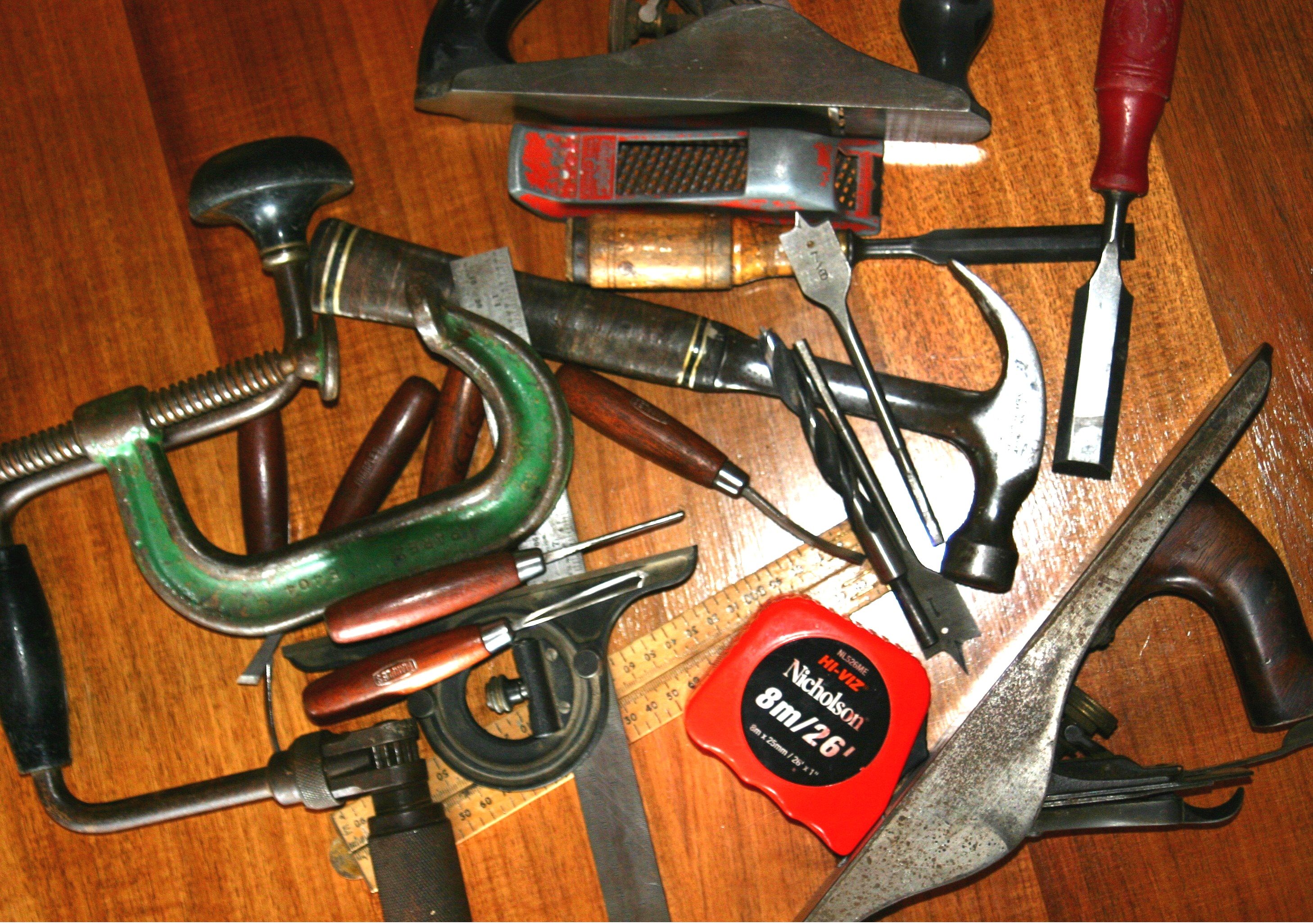
Walk into any small-scale woodworking workshop in the Czech Republic — whether in a converted stable in the Šumava foothills or a ground-floor unit in Brno's Židenice district — and the same category of tools appears on every bench: chisels, hand planes, handsaws, and mallets. These are not decorative remnants of an older era. They are the instruments that determine whether a joint fits precisely or gaps under load.
Power tools cut material faster. Hand tools cut it with more control. The distinction matters most at final stages: cleaning up a shoulder cut, paring a tenon cheek to a friction fit, or flattening a glue surface before assembly. This guide documents what each hand tool does and how Czech craftsmen integrate it into daily work.
Chisels
A bench chisel is the most versatile single-edge cutting tool in a joiner's kit. The blade is ground to a bevel — typically 25° for general paring, 30° for chopping end grain — and pushed or struck with a mallet to remove wood in controlled increments.
Czech workshops commonly stock sets of four or five bench chisels in widths from 6 mm to 25 mm. The 12 mm chisel handles the widest range of tasks: cleaning mortise walls, paring hinge recesses, and refining dovetail baseline cuts. Firmer chisels — with thicker blades — are preferred when striking with a mallet. Paring chisels, ground at a lower angle, are used by hand only, typically for fitting joints to final dimension.

Sharpening protocol matters as much as the tool itself. Most experienced woodworkers in Czech ateliers sharpen to a polished edge on a water stone, finishing at 8000 grit before each working session. A chisel that drags rather than slices through end grain produces torn fibers and inaccurate cuts — problems that become visible at assembly.
Hand Planes
Hand planes flatten, square, and smooth surfaces to a standard that orbital sanders cannot replicate. A well-tuned smoothing plane leaves a burnished surface that reflects light uniformly — a quality valued in high-end Czech furniture production because it requires no additional finishing before applying oil or wax.
Three types appear in most Czech workshops:
- Jack plane (No. 5): The first plane used on rough-sawn lumber. The blade is slightly cambered to take heavy shavings and remove high spots quickly. Length of 356 mm gives it enough span to reference flat areas.
- Try plane (No. 7): 559 mm long, used to establish true flatness across wide panels. The length bridges low spots that shorter planes would follow.
- Smoothing plane (No. 4): Final surface preparation before finishing. Set for a very fine shaving — 0.05 mm or less. Used across the grain to remove any remaining machine marks.
Beyond bench planes, a shoulder plane is indispensable for fitting tenon cheeks and rabbets precisely. The blade runs full-width to the sole, which allows it to pare right to a scribed line on end grain — something a bench plane cannot do accurately.
Handsaws
The distinction between rip and crosscut sawing determines which handsaw is appropriate for a given cut. Rip teeth are filed with flat fronts to act like miniature chisels, slicing along the grain. Crosscut teeth are filed at an angle to sever fibers across the grain. Using a rip saw for crosscutting, or vice versa, produces ragged, overworked cuts.
Czech joiners generally rely on two types:
- Panel saw: 500–550 mm, general crosscutting of boards and rough dimensioning. The more aggressive tooth geometry — 7 to 10 points per inch — cuts faster but leaves a rougher kerf edge.
- Tenon saw (back saw): A reinforced spine along the top of the blade prevents flexing. Tooth pitch is finer — 13 to 15 points per inch — producing a kerf narrow enough for accurate joinery. Used for all precision cuts: tenon shoulders, dovetail sides, box joint walls.
Mallets
A wooden mallet is the correct striking tool when working with chisels and wooden-handled gouges. Steel hammers concentrate force on a single point and split handles quickly. A mallet distributes the strike across the full face of the handle, reducing fatigue and protecting the tool.
Most Czech workshops use a round-headed mallet in beech or hornbeam — both locally available hardwoods with the density to deliver firm blows without bouncing. The weight ranges from 340 g to 500 g. Lighter mallets work well for detail chiseling; heavier ones for driving mortise chisels through dense oak.
Marking and Measuring Tools
Accuracy in hand-tool woodworking begins at layout, not cutting. Three instruments define the marking process:
- Marking gauge: Scratches a line parallel to an edge at a set distance. Used to define tenon thickness, mortise position, and rabbet depth. The single-point variant scribes a clean line in cross grain; a cutting-wheel gauge severs fibers cleanly instead of tearing them.
- Combination square: Verifies 90° and 45° relationships, marks lines across faces and edges, and checks that surfaces are co-planar. A 300 mm blade is the most practical size for bench work.
- Marking knife: Preferred over pencil for joinery layout. The knife severs wood fibers along a precise line, giving the chisel a defined registration point and preventing tear-out at the joint baseline.
"The hand tools do not slow the work down. They give you a surface and a fit that the machine cannot produce on its own." — Milan Dvořák, cabinetmaker, Olomouc
Building a Starter Kit
For anyone beginning to work with hand tools in a Czech context — where hardwoods like beech and oak are the default bench materials — a functional starter set covers the following:
- Four bench chisels: 6, 12, 19, and 25 mm
- A No. 4 smoothing plane and a No. 7 try plane
- A shoulder plane, 18 mm wide
- A 500 mm panel saw and a 300 mm tenon saw
- A beech mallet, 450 g
- A marking gauge and a 300 mm combination square
- A water stone set: 800/1200/4000/8000 grit
This set handles all common joinery operations — marking and cutting mortises, fitting tenons, hand-planing panels flat, and scribing accurate baselines for dovetails. It is also sufficient for the work described in the other articles on this site.
Further reading: Fine Woodworking — Hand Tool Guide and Popular Woodworking — Techniques.

